




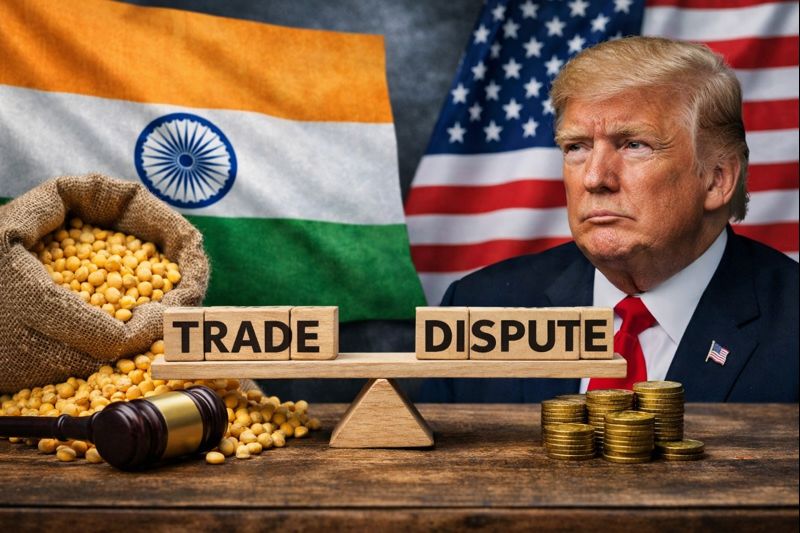
Talks over the India–US trade agreement may face renewed challenges as pulses become a new point of dispute. Two senior US lawmakers have written to former President Donald Trump, urging him to intervene over India’s 30% import tariff on American pulses, warning that the move puts US farmers at a serious disadvantage.
Why India’s Pulse Tariff Is Causing Concern
India is the world’s largest consumer of pulses, accounting for nearly 27% of global consumption. Commonly consumed items include lentils, chickpeas, dried beans, and peas, which are staple foods across Indian households.
However, the Indian government announced a 30% import duty on yellow peas on October 30, with the tariff coming into force from November 1, 2025. This decision has drawn criticism from US agricultural leaders and lawmakers, who see it as a major trade barrier.
US Lawmakers Raise the Issue With Trump
Who Signed the Letter?
The letter was jointly sent by Republican Senators Steve Daines of Montana and Kevin Cramer of North Dakota—states that are the top pulse-producing regions in the United States.
Key Points Raised in the Letter
-
The senators said Indian tariffs on US pulses are unfair and harm American farmers.
-
They argued that US producers face a “significant competitive disadvantage” in the Indian market.
-
The lawmakers urged Trump to raise the pulse tariff issue directly with Prime Minister Narendra Modi.
-
They stressed that reducing tariffs would be mutually beneficial, helping US farmers and offering better prices to Indian consumers.
Impact on India–US Trade Negotiations
The tariff dispute comes at a sensitive time, especially after the US previously imposed punitive 50% tariffs on certain Indian goods, escalating trade tensions between the two countries. Analysts believe the pulse tariff issue could slow down or complicate ongoing trade negotiations.
The senators also recalled that during Trump’s first term, a similar concern was raised ahead of the 2020 India visit. At that time, Trump reportedly hand-delivered their letter to PM Modi, which helped reopen discussions on agricultural trade.
US Farmers Seek Fair Market Access
In their message, the lawmakers emphasized that American farmers have the capacity to supply high-quality pulses globally if trade barriers are reduced.
They stated that as the US works to rebalance global trade, American agricultural producers are ready to play a key role—provided markets like India become more accessible.
They also referenced the removal of India from the Generalised System of Preferences (GSP) in 2019, after which additional duties were placed on US exports, further affecting pulse producers.
What Lies Ahead for the Trade Deal?
With pulses now added to the list of trade disputes, the future of the India–US trade deal remains uncertain. Whether diplomatic engagement can ease tariff tensions will be critical in determining the direction of bilateral economic relations.
For now, agriculture trade, especially pulse imports and exports, has emerged as a key test for cooperation between New Delhi and Washington.