




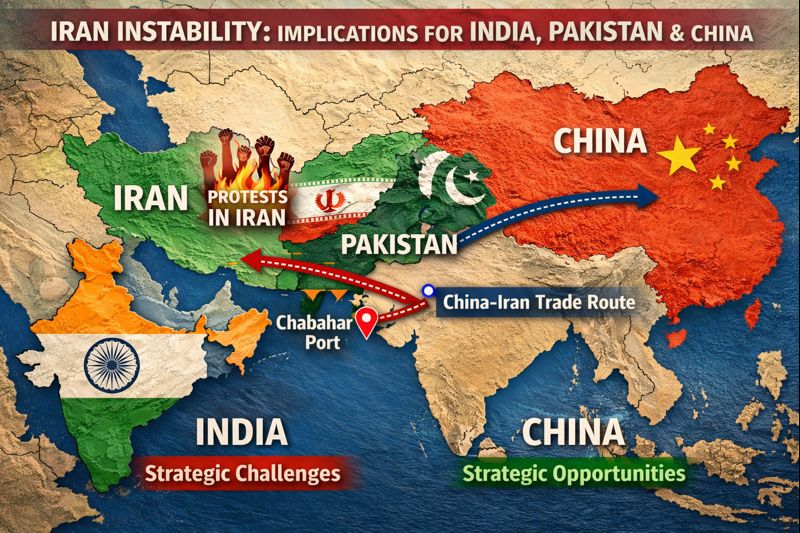
India is closely monitoring the unfolding political unrest in Iran, as any major shift in Tehran’s leadership could significantly reshape regional geopolitics, trade routes, and security alignments. While a weakened Iran may open strategic opportunities for Pakistan and China, it could sharply limit India’s influence and access in West and Central Asia.
With India already facing growing challenges from China’s regional expansion, cross-border terrorism from Pakistan, and shifting global power dynamics, instability in Iran adds another layer of strategic concern.
Why Iran Is Strategically Important for India
Iran as India’s Only Western Gateway
For decades, Iran has been India’s most reliable access route to Afghanistan and Central Asia, especially since Pakistan blocks overland transit for Indian trade and diplomacy. This makes Iran a critical partner in India’s connectivity and foreign policy strategy.
Any political collapse or prolonged unrest in Tehran could severely disrupt this access, reducing India’s room to manoeuvre in the region.
Chabahar Port: A Pillar of India’s Regional Strategy
Bypassing Pakistan Through Iran
At the heart of India–Iran cooperation lies the Chabahar Port, a strategic infrastructure project developed with Indian investment. The port allows India to connect with Central Asian markets through Iran’s road and rail networks, completely bypassing Pakistan.
India has invested over $1 billion in Chabahar and related infrastructure. However, such long-term projects depend on political stability, security guarantees, and policy continuity—all of which could be threatened by regime change.
Experts warn that in a post-leadership transition scenario, Chabahar could shift from a strategic asset to a geopolitical liability.
Pakistan’s Strategic Advantage If Iran Weakens
Loss of a Regional Counterbalance
Despite being a Muslim-majority nation, Iran has historically countered Pakistan’s influence, particularly in Afghanistan. Iran’s Shia leadership has openly opposed Sunni extremist groups operating from Pakistan and targeting Indian interests.
In the 1990s and early 2000s, India and Iran jointly supported anti-Taliban forces, limiting Pakistan’s efforts to dominate Afghanistan. Tehran also backed India diplomatically during key international disputes.
If Iran becomes internally unstable, Pakistan stands to benefit, as one of its strongest regional counterweights would weaken.
Trade and Investment Risks for India
Economic Exposure to Political Uncertainty
India is currently Iran’s eighth-largest trading partner, with bilateral trade valued between $1.3 billion and $1.7 billion annually. While trade volumes have already been affected by US sanctions, a regime change could further disrupt agreements and investments.
Any rollback, renegotiation, or cancellation of projects—especially at Chabahar—would directly affect Indian public funds and long-term economic planning.
China’s Growing Influence in Iran
Beijing’s Strategic Opportunity
While Iran has often aligned with India on Pakistan-related concerns, China remains Iran’s most powerful economic partner. In 2021, Beijing and Tehran signed a 25-year strategic cooperation agreement, strengthening ties in energy, infrastructure, and defence.
China became Iran’s largest trading partner, importing over $14.5 billion worth of goods in 2025, mainly discounted oil. With Western sanctions limiting Iran’s options, Beijing has emerged as Tehran’s most dependable economic lifeline.
India’s presence in Iran—particularly at Chabahar—has acted as a modest counterweight to Chinese influence. However, continued instability could push any future Iranian government to lean even more heavily on China for investment, security, and diplomatic support.
Reports suggest that Chinese-funded infrastructure projects, including ports and power plants, are already being discussed in key Iranian regions.
India’s Diplomatic Path Forward
Strategic Caution Over Political Posturing
Former Indian diplomat Nirupama Menon Rao has emphasised the need for a measured and cautious approach. According to her, the situation in Iran has reached a point where external actors cannot shape outcomes reliably.
India’s immediate priority should be:
-
Protecting Indian citizens in Iran and the wider region
-
Strengthening consular preparedness and evacuation plans
-
Maintaining open communication channels with all stakeholders
Rather than reacting hastily, India must assess multiple possible scenarios and prepare for long-term regional consequences.
Wider Regional Impact of an Unstable Iran
Why India Cannot Ignore the Fallout
A fragmented or unstable Iran would not remain a local issue. Its effects could spread rapidly through:
-
Global energy markets
-
Shipping and trade routes
-
Diaspora security concerns
-
Militant and criminal networks
Such spillovers could directly impact South Asia, making stability in Iran a matter of strategic necessity for India.
Conclusion: A Test of India’s Strategic Resilience
A regime change in Iran presents a complex geopolitical challenge. While Pakistan and China may find new opportunities, India risks losing a crucial partner that supports its regional connectivity, security interests, and diplomatic balance.
India’s best response lies in strategic restraint, steady engagement, and continuous assessment—focusing on preparedness rather than rhetoric, and long-term interests over short-term reactions.