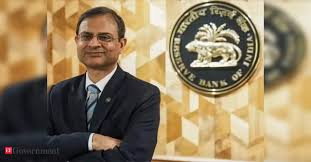

The Reserve Bank of India’s Monetary Policy Committee (MPC), operating under the leadership of Governor Sanjay Malhotra, has unanimously decided to keep the benchmark repo rate unchanged at 5.25% while maintaining its neutral policy stance, a cautious move driven by a complex mix of solid internal growth and worsening external economic pressures. Even though fresh data from the Ministry of Statistics and Programme Implementation officially confirmed that India’s economy grew by a highly resilient 7.7% over the last fiscal year, the central bank took proactive steps to downgrade its real GDP growth forecast for the upcoming 2026–27 fiscal period down to 6.6% from its previous estimate of 6.9%. This downward revision directly reflects deepening anxieties over a prolonged and unresolved conflict in West Asia, which has systematically disrupted critical global supply chains, caused a sharp depreciation in the Indian rupee toward record lows against the US dollar, and triggered aggressive capital outflows from Foreign Portfolio Investors (FPIs). Simultaneously, the central bank raised its consumer price index (CPI) headline inflation projection for the full fiscal year up to 5.1%, directly warning that a series of localized retail fuel price hikes implemented in late May—which pushed petrol up by 7.4% and diesel by 8.4%—will directly inject an immediate 36 basis points of upward pressure into the core domestic pricing indices. Adding to this supply-side shock, domestic food inflation is feeling the heat as a severe summer heatwave across multiple agricultural belts has triggered a sharp rebound in vegetable and essential commodity prices, a baseline vulnerability that could become significantly worse given the India Meteorological Department’s latest warning that the incoming southwest monsoon could potentially stand as the weakest the country has witnessed in eleven years. While demand-driven inflation pressures remain generally contained across urban centers, the central bank emphasized that a rate cut at this volatile juncture would send an entirely wrong signal to financial markets, stating that monetary policy tools cannot repair geopolitical tensions or produce rainfall, thus necessitating an extended period of policy restraint. Consequently, the commercial banking sector expects immediate lending and deposit rates, including home loan EMIs, to remain completely frozen for the foreseeable future, as Dalal Street investors and corporate strategists shift their immediate attention toward a massive structural revamp of India’s inflation monitoring framework, which is set to debut three entirely new Producer Price Indices (PPI) later this month to better track input costs and service-sector inflation.
Macro-Economy: RBI Holds Repo Rate at 5.25% and Trims GDP Forecast Amid Supply-Driven Inflation Spikes